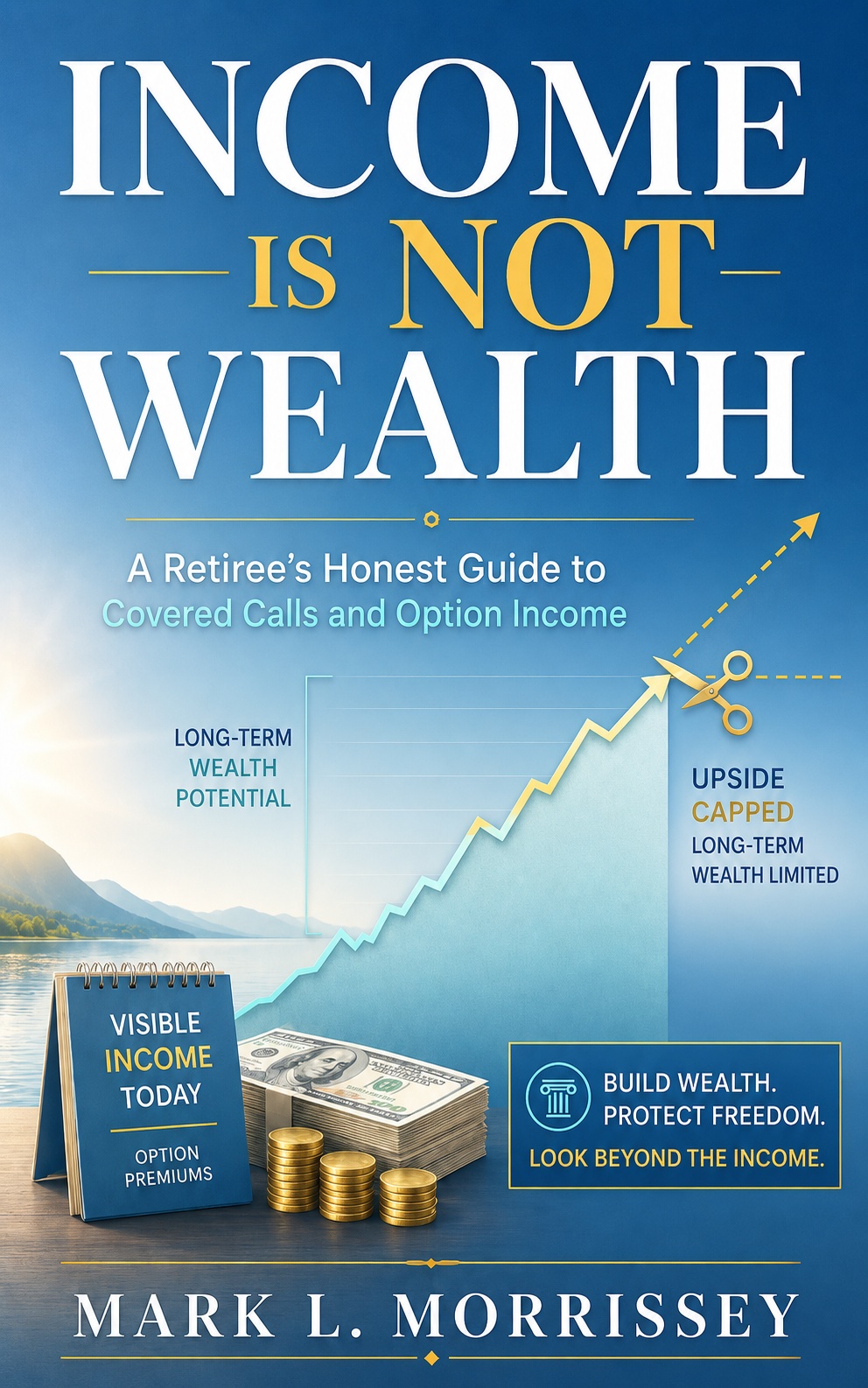
Plain-English guide
Covered-call ETFs are popular with income-oriented investors because they turn option premium into regular-looking cash flow. For a retiree, that can be emotionally appealing. A deposit appears. The yield looks large. The strategy sounds more conservative than owning stocks outright.
That does not make the strategy bad. It does mean the strategy must be judged carefully. A covered-call ETF is not a bond, not a dividend stock, and not a machine that converts market volatility into free retirement income.
The practical view is this: a covered-call ETF may be useful in a limited role for some retirees, but it should not be evaluated by yield alone.
Why the yield can be misleading
A covered-call ETF usually owns an underlying asset or index exposure and sells call options against some or all of that exposure. The option premium helps fund distributions. The tradeoff is that the fund gives away some upside if the underlying asset rises above the option strike.
That is the central exchange. The investor receives cash today in return for selling part of the future upside. In calm or sideways markets, that can feel satisfying. In strong rising markets, the strategy can lag. In falling markets, the premium may soften losses but usually does not eliminate them.
Working rule: Distribution yield is not the scoreboard. Total return is the scoreboard. A fund can pay cash every month and still leave the investor poorer if the price or net asset value falls enough.
Three market environments to think through
| Market environment | What may happen | Retiree question |
|---|---|---|
| Sideways or choppy market | Call premium may help returns and provide cash flow. | Is the cash flow worth the fees, taxes, and complexity? |
| Strong rising market | The fund may lag because upside has been sold away. | Am I comfortable giving up part of a bull market? |
| Sharp falling market | Premium may cushion losses somewhat, but the underlying exposure can still decline. | Would I still hold this if the price fell while distributions continued? |
Five questions before buying a covered-call ETF
- What is the total return, not just the distribution yield? Compare the fund's price change plus distributions against a sensible benchmark over several periods.
- How much upside does the strategy give away? Some funds sell calls close to the money; others sell farther out. The more upside is sold, the more the fund may lag in a strong rally.
- Is the distribution coming from sustainable return, option premium, return of capital, or some combination? The label matters less than the economics: is the capital base growing, stable, or shrinking?
- What happens after taxes? Frequent distributions can be less attractive in a taxable account than in a tax-advantaged account.
- What role does this fund play in the whole portfolio? A small income sleeve is different from replacing a diversified equity position with a high-yield product.
NAV erosion: the quiet risk
Net asset value erosion means the capital base of the fund declines over time. This can happen for many reasons: weak underlying performance, high distributions, strategy design, market drawdowns, or paying out more than the strategy earns over a full cycle.
A retiree should not look only at the monthly payout. Look at whether the investment value is holding up. If the account receives cash but the fund price keeps falling, the income may be partly an illusion of comfort.
Important caution: A high distribution can make a declining investment feel productive. The question is not, “Did I get paid?” The question is, “After the payment and the price change, am I actually ahead?”
When a covered-call ETF might make sense
A covered-call ETF can make sense when the investor understands the tradeoff and uses the fund for a specific purpose. It may fit a retiree who wants some current cash flow, accepts limited upside, keeps the allocation modest, and evaluates the result by total return rather than income appearance.
It may also be more reasonable in an account where tax treatment is less punishing, or as a deliberate substitute for part of an equity allocation rather than a replacement for safe cash or bonds.
When to be cautious
Be more cautious if the purchase is driven mainly by the advertised yield. Also be cautious if the fund is being used to solve a spending problem, replace emergency reserves, or create the impression that retirement income is safer than it really is.
Covered-call strategies are often marketed as income solutions. They are better understood as risk-tradeoff solutions. The investor is not getting something for nothing. The premium is the price received for giving another investor an option.
A better comparison
Before buying, compare the covered-call ETF with three alternatives:
- The underlying index or ETF. What did the covered-call version add or subtract?
- A simple stock-and-cash mix. Could similar risk be achieved with less complexity?
- A Treasury bill or short-term bond fund alternative. If the goal is cash flow and stability, is option income really the right tool?
The right comparison prevents the common mistake of comparing a risky option-income fund against a checking account. That makes the yield look impressive but hides the equity-like risks.
The practical conclusion
Covered-call ETFs are not automatically bad for retirees. They are also not automatically conservative. They are best treated as specialized equity-income tools with explicit tradeoffs: cash flow now, capped upside later, continuing downside risk, possible tax drag, and the need to evaluate total return.
The core question is simple: would you still want the strategy if the advertised yield were removed from the headline? If the answer is no, the yield may be doing too much of the persuasion.